
How Madhubani Art Helped Me Become More Mindful and Present
The first thing Madhubani art taught me was to slow down without making a big announcement about it.
I did not start with a grand goal. I was not trying to become calmer, wiser, or more disciplined. I only wanted to fill a blank page with lines, colours, and patterns that reminded me of something rooted and handmade. Yet after a few sessions, I noticed a small shift. My breathing became steadier. My phone stayed face down for longer. My mind, which usually jumped from one unfinished thought to another, began to stay with the curve of a fish, the border of a leaf, or the repeated dots around a flower.
That was the quiet gift of Madhubani art. It did not ask me to empty my mind. It gave my mind one beautiful thing to do at a time.

Madhubani art invited me to focus on one line at a time
Madhubani art comes from the Mithila region, across parts of Bihar in India and Nepal. Traditionally, artists used it to decorate walls, floors, and later paper and cloth. The style is known for fine outlines, filled spaces, repeated patterns, natural forms, and stories drawn from daily life, folklore, and devotion.
When I first looked at a completed Madhubani painting, it felt complex. Every corner seemed alive. There were borders inside borders, leaves within leaves, fish scales, lotus petals, eyes, birds, trees, sun shapes, and tiny marks filling the space.
Trying to copy that energy at once felt overwhelming. Then I realised the art does not happen all at once. It grows line by line.
I began with simple forms:
A border around the page
A central fish or lotus
Small leaves around the main shape
Repeated dots and strokes to fill the empty areas
A limited set of colours
This helped me stop rushing towards the final picture. The page made more sense when I stayed with the line in front of me. If I was drawing a petal, the petal deserved my full attention. If I was filling a border with tiny triangles, the border was enough.
That habit slowly moved into the rest of my day. Washing a cup could just be washing a cup. Walking to the nearby shop could just be walking. I did not need to turn every small act into a race.
Madhubani art helped me become more mindful and present because it trained my attention through repetition. Not in a strict way. In a gentle, absorbing way.
The repetition became a form of rest
Many mindfulness practices ask us to watch the breath, repeat a phrase, or notice sensations in the body. Madhubani art gave me a visual version of that practice.
A row of dots became a rhythm. A line of leaves became a count. A border repeated on all four sides became a quiet reminder to return whenever the mind wandered.
At first, I would get impatient. I wanted the page to look finished. I wanted the painting to become “good” quickly. I would press too hard with the pen or rush through the filling patterns. The result showed it. The lines became uneven. The colours looked hurried. The page felt tense.
Then I began to enjoy the slowness.
There is something deeply grounding about repeating a shape with care. The hand moves. The eye follows. The mind settles into the pattern. After a while, I stopped asking, “How much is left?” and started noticing, “This line is slightly softer than the last one.”
That small change mattered. It made the process more important than the outcome.
The page did not need me to perform. It only needed me to return.
This is where the practice felt different from scrolling, watching, or consuming. Madhubani art required my presence, but it did not exhaust me. It gave me a rhythm I could enter when the day felt scattered.
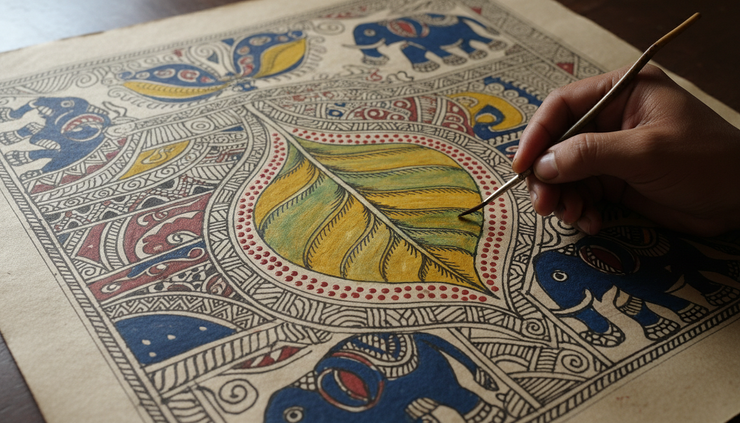
Imperfection taught me to be kinder to myself
A strange thing happens when you draw slowly. You notice every flaw.
One line bends where it should be straight. One eye looks larger than the other. A dot lands outside the border. The colour spreads beyond the outline. In the beginning, I found these little mistakes irritating. I wanted to fix everything.
But traditional handmade art carries the trace of the person who made it. The slight unevenness is not a failure. It is proof of the hand.
That idea changed the way I looked at my own work. A machine can repeat a perfect line. A human hand brings pressure, breath, mood, speed, hesitation, and care. My painting did not have to look like a printed design. It had to feel alive.
This became one of the most useful lessons for my daily life. I often carried the same need for control into simple moments. If a plan changed, I became restless. If I could not finish a task neatly, I felt behind. If a day did not match the version I had imagined, I treated it like a spoiled page.
Madhubani art softened that habit.
When a line went wrong, I learnt to work with it. I could thicken the border. Add a pattern. Turn the mistake into a small flower, a leaf, or a decorative mark. The page rarely rejected me. It kept offering ways to continue.
That is a powerful lesson in presence. Mindfulness is not about keeping life neat. It is about meeting what is already here with patience.
Colour brought me back to the senses
I spend a lot of time in my head. Plans, memories, worries, half-written messages, things to buy, people to call. Colour pulls me out of that mental noise and brings me back to what I can see and touch.
In Madhubani art, colour is not only decoration. It carries mood, contrast, and life. Even when using simple poster colours or handmade pigments at home, the act of choosing colours becomes a sensory practice.
I started noticing small things:
How yellow changes when placed beside red
How green calms a crowded design
How black outlines hold the whole picture together
How white space can make a pattern breathe
How the same blue feels different in a fish, a peacock, or a border
These choices kept me in the present. I had to look closely. I had to notice what the painting needed now, not what I had planned ten minutes ago.
Some days, I used bright colours because I felt dull. Some days, I used softer colours because I wanted quiet. There was no rule that every page had to carry the same mood. The painting became a record of where I was, without needing to explain it.
This is one reason folk art can feel so personal even when it follows a traditional style. There are shared motifs, but every hand makes them differently. A lotus can look joyful, still, bold, shy, crowded, or spacious depending on the person drawing it.
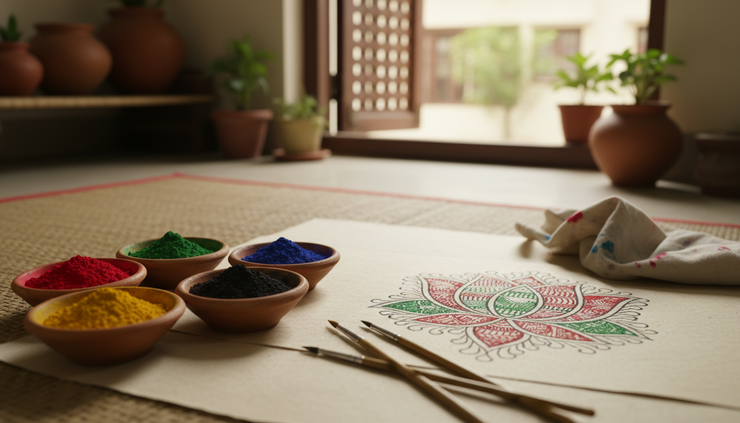
The motifs helped me feel connected
Madhubani art often includes fish, peacocks, elephants, the sun, the moon, lotus flowers, trees, and scenes inspired by mythology and everyday life. These forms are not random. Many of them symbolise fertility, devotion, abundance, nature, and protection.
Even when I drew them in a simple way, I felt connected to something larger than my own mood. A fish was not just a fish. It carried movement and life. A tree was not just a tree. It suggested shelter, growth, and continuity. A sun reminded me of warmth and daily return.
That connection made my practice feel less lonely.
Mindfulness can sometimes be presented as a private activity, done with closed eyes in a quiet room. Madhubani art opened another path. It made presence feel connected to culture, memory, and earth. It invited me to notice the natural world, even on a busy day.
After drawing leaves for an hour, I began noticing real leaves more closely. After filling a fish with scales, I paid more attention to patterns on vegetables, fabrics, temple walls, and rangoli designs. The art trained my eyes to see detail.
That seeing is a kind of mindfulness too.
I learnt to create a small ritual around the practice
The biggest shift came when I stopped treating Madhubani art as a hobby I would do only when I had “enough time”. If I waited for a perfect free afternoon, I rarely began. So I made the practice smaller.
I kept a simple kit ready:
A sketchbook or thick paper
A black pen
Two or three brushes
A few colours
A small cloth
A reference image or old sketch
Then I set a timer for 20 minutes. That was enough.
Some days, I only drew a border. Some days, I filled one section with dots. Some days, I added colour to a half-finished piece. The smallness helped. I did not need to complete a painting to feel the benefit.
Before starting, I took a few slow breaths and looked at the blank page. I chose one shape. I began.
This simple ritual made the practice easier to return to. It also gave my mind a clear signal. For the next few minutes, I did not need to solve everything. I only needed to draw.
If you want to try this, start with a very simple Madhubani-inspired pattern. Choose one central motif, such as a fish, leaf, lotus, or sun. Draw a border. Repeat small marks to fill the space. Keep your phone away. Let the page take the time it takes.
The goal is not to become an expert in one sitting. The goal is to stay with the act of making.
What Madhubani art changed in my daily life
The changes were not dramatic. I did not become a completely calm person who never gets distracted. I still rush. I still overthink. I still pick up my phone without meaning to.
But I return faster now.
When I feel scattered, I know what it feels like to come back to one line. When I feel impatient, I remember how a border becomes beautiful only through repeated care. When I make a mistake, I remember that the page can still hold it.
That is the real value of this practice. It gives the body a memory of attention.
Madhubani art also changed my idea of creativity. I used to think creativity needed inspiration. Now I think it also needs presence. Inspiration may start a piece, but attention completes it. The quiet work of filling, correcting, choosing, and continuing teaches a patience that cannot be rushed.
This patience has travelled into other parts of life. I listen a little better. I notice details more often. I pause before reacting. I enjoy handmade things more deeply. I feel less pressure to turn every free moment into a productive one.
A page, a pen, and a few colours became a small place to practise being here.
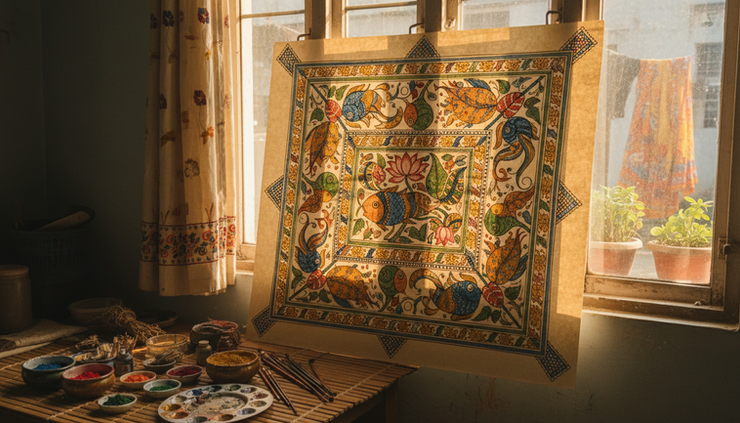
A simple practice to begin with today
If the idea of starting feels intimidating, keep it modest. Try this 30-minute practice.
Draw a rectangle border
Leave some space at the edges. Add a second line inside it.
Choose one central shape
A fish, flower, leaf, or sun works well. Keep the outline simple.
Fill the empty space with repeated marks
Use dots, short lines, curves, triangles, or tiny leaves.
Use only three colours
Limiting the palette makes the process calmer and easier.
Pause before calling it finished
Look at the page for a minute. Notice the areas your hand returned to again and again.
This practice is not about judging the artwork. It is about noticing how you feel while making it. Are you rushing? Are you holding your breath? Are you trying to make it perfect? Can you soften your grip and continue?
Those questions are where the mindfulness begins.
Madhubani art helped me become more mindful and present not because it removed distraction from my life, but because it gave me a way back. Each line became a small return. Each pattern became a place to rest. Each colour asked me to look again.
The page is still teaching me. Slowly, patiently, one mark at a time.

Comments